
•
Published
Google Web3 has integrated Self Protocol's zero-knowledge (ZK) proof-of-humanity solution into its Celo Sepolia testnet faucets, marking the first production deployment of the Google Cloud and Self Protocol partnership. The integration addresses Sybil attacks and bot abuse in blockchain testnet environments while preserving developer privacy through advanced cryptographic verification.
Solving Sybil Attacks in Web3 Testnet Faucets
Testnet faucets provide essential infrastructure for blockchain developers, distributing tokens needed for smart contract deployment, testing, and experimentation. However, automated bot networks and AI-generated fake accounts have increasingly exploited these resources, draining faucet supplies and limiting availability for legitimate developers.
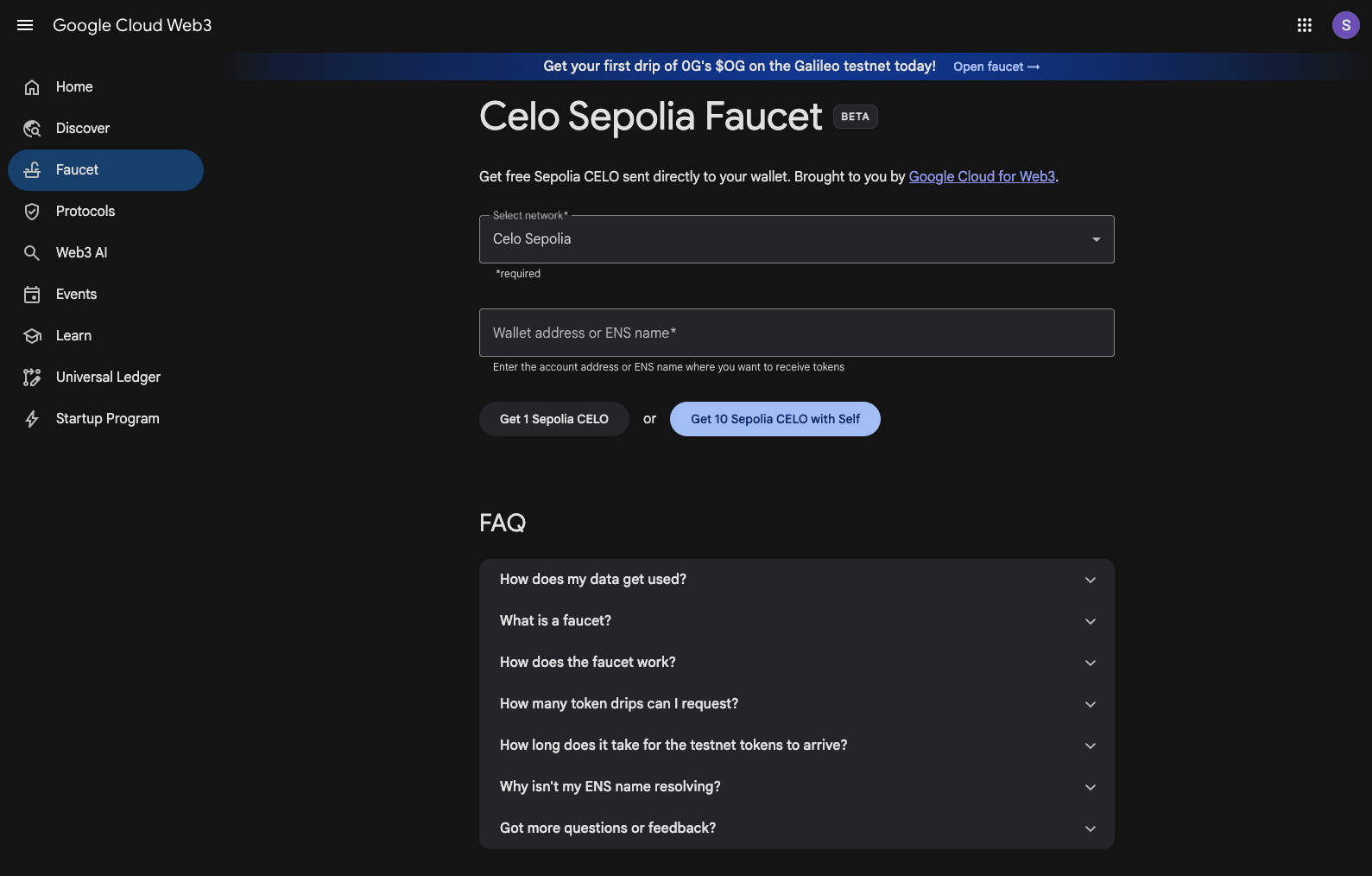
The Self Protocol integration implements Sybil-resistant token distribution through privacy-preserving humanity verification. Developers can verify they are real humans over age 18 without disclosing sensitive personal information such as date of birth, government identification, or residential location. Verified users receive up to 10x more testnet tokens in subsequent allocations compared to non-verified users.
"We are making testnet faucets useful again for real, human developers after bots have overwhelmingly exhausted resources across the industry," said Eric Nakagawa, Self Protocol co-founder and CEO. "With privacy as the cornerstone of Self's infrastructure, builders can claim the testnet tokens they need in seconds without disclosing private personal information."
Zero-Knowledge Proof-of-Humanity Technology
Self Protocol leverages zero-knowledge cryptography to enable humanity verification without compromising user privacy. The system generates cryptographic proofs that confirm a wallet belongs to a verified human meeting age requirements, without revealing underlying personal data to Google, Self Protocol, or third parties.
The faucet receives binary verification signals—confirmed human status and age compliance—sufficient for enhanced token allocations and Sybil protection, without creating centralized databases of sensitive information.
"We're committed to ensuring developers can build faster with reduced friction while maintaining industry-leading security standards," said Rich Widmann, Head of Strategy, Web3 at Google. "Integrating Self allows us to further this mission with frontier zero-knowledge solutions that benefit developers throughout the blockchain ecosystem."
The Next Step: First-of-Its-Kind Mainnet Faucet
The Celo Sepolia testnet integration lays the foundation for the next milestone: a first-of-its-kind mainnet faucet. This upcoming deployment will distribute real-value tokens to verified humans at higher allocation rates, creating economic incentives for proof-of-humanity adoption while protecting protocol resources from automated exploitation.
The planned mainnet faucet will align resource allocation with genuine human participation, protect scarce infrastructure from bot networks, and establish Sybil-resistant onboarding without sacrificing decentralization.
Strategic Benefits for Platforms and Developers
For infrastructure providers like Google Cloud Web3, the integration delivers practical Sybil resistance while building relationships with verified human developers. Limited resources can be allocated efficiently to builders demonstrating genuine participation.
For developers, verification offers immediate benefits: increased token access, enhanced platform capabilities, and streamlined onboarding. Rather than functioning as compliance friction, humanity verification becomes a value-generating primitive that opens access to premium features.
Self's Growing Role in Identity Infrastructure
The Google Web3 integration reinforces Self Protocol's position as emerging identity infrastructure for major Web3 platforms. Self Protocol currently powers humanity verification for leading protocols including Aave, Velodrome, Talent Protocol, and Lemonade Social, supporting:
Enhanced yields and incentive rewards for verified human participants in DeFi protocols
Age-gated event registration and community access controls
Anti-Sybil protections for token distributions, airdrops, and governance mechanisms
Addressing AI-Amplified Sybil Threats
The integration arrives as AI capabilities increasingly amplify Sybil attack sophistication. Generative AI models can create realistic transaction histories, simulate human behavioral patterns, and orchestrate wallet farms at unprecedented scale. Traditional detection methods become less effective as AI-generated activity becomes indistinguishable from organic usage.
Zero-knowledge proof-of-humanity provides cryptographic guarantees that resist AI-generated impersonation through verification methods that automated systems cannot replicate, regardless of model sophistication.
The Future of Human-Verified Web3 Infrastructure
The Google Web3 and Self Protocol integration demonstrates how privacy-preserving cryptography can distinguish human participants from automated agents without compromising decentralization. The testnet faucet deployment represents the first step, with the mainnet faucet as the next milestone in transforming identity infrastructure to recognize and reward human participation.
The initiative signals industry momentum toward privacy-preserving identity as a core Web3 primitive. As this infrastructure matures, blockchain platforms gain practical tools to build sustainable, Sybil-resistant ecosystems that reward genuine participation without sacrificing privacy and decentralization principles.
Prove your humanity and Get 10 CELO with Self: https://cloud.google.com/application/web3/faucet/celo/sepolia
Published
Related blogs


Stay updated
Join us on the road to privacy-first identity.